

Whether you’re starting your first website or looking to improve an existing one, What Is Semrush? A Beginner’s Guide to SEO in 2026 explains how Semrush gives you the data and tools you need to make better SEO decisions and grow your visibility in search engines.
Table of Contents
What is Semrush?
Semrush is an all-in-one SEO platform that helps website owners research keywords, analyze competitors, improve content, check technical SEO issues, and track search engine rankings.
Why do beginners need an SEO tool?
SEO can be difficult when you are just starting. The right tool can help you understand what people are searching for, find better keyword opportunities, identify problems on your website, and make smarter SEO decisions without relying on guesswork.
What will you learn in this guide?
In this guide, you’ll learn what Semrush is, how it works, what its main features do, and how beginners can use it to improve their SEO. We’ll also look at its pricing, pros and cons, alternatives, and whether Semrush is worth using in 2026.
1.What Is Semrush?
Semrush is an all-in-one SEO tool that helps you find keywords, analyze competitors, improve your website, optimize content, and track your search engine rankings.
Semrush helps you improve your SEO by providing data and tools for keyword research, competitor analysis, website audits, content optimization, and rank tracking. It shows you what is working, what needs improvement, and where you can find new opportunities to grow your website.
Semrush is used by beginners, bloggers, website owners, marketers, SEO professionals, and businesses that want to improve their online visibility. Beginners can use it to find keywords, understand competitors, optimize their content, and track their website’s SEO progress.
2.How Does Semrush Work?
Semrush works by collecting and organizing SEO data in one platform. You enter a website or keyword, and Semrush provides useful information about rankings, search volume, competitors, backlinks, and website performance. You can then use this data to find opportunities, fix SEO problems, and improve your content.
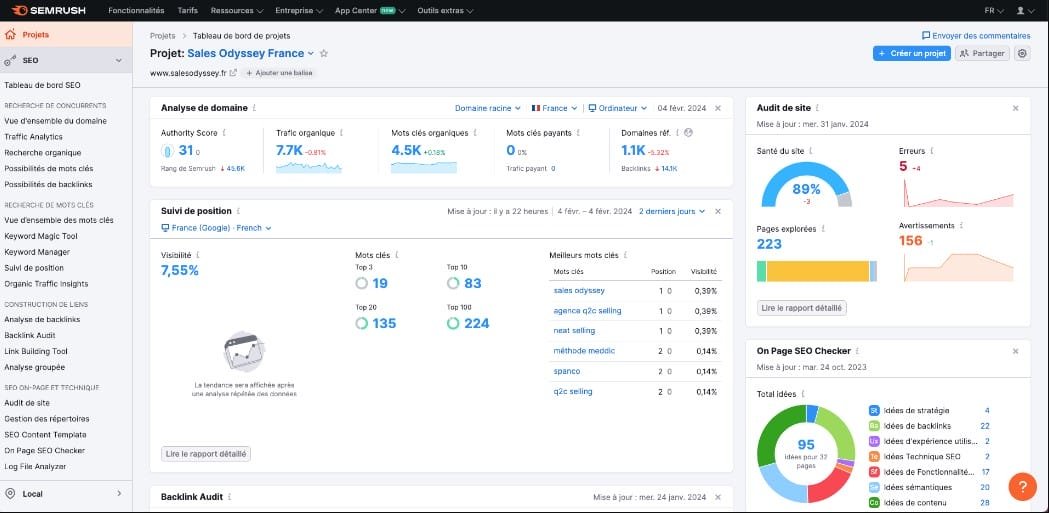
Semrush collects SEO data from different sources and organizes it into easy-to-read reports. It analyzes information about keywords, search rankings, competitors, backlinks, and website performance. The platform then presents this data through dashboards, charts, and reports, making it easier to understand your SEO performance and find opportunities for improvement.
3.What Can You Do With Semrush?
Semrush offers a variety of tools that can help you improve your website’s SEO and grow your online visibility. From finding valuable keywords to analyzing competitors and tracking rankings, you can use Semrush to understand what is working and discover what you can improve.
Semrush gives you a range of tools to improve your website’s SEO and online visibility. Beginners can use it to:
- Keyword research : Semrush helps you find keywords that people are searching for on Google. You can use it to discover search volume, keyword difficulty, search intent, and related keywords, making it easier to choose the right terms for your content and attract more relevant visitors
- Competitor analysis : Semrush helps you understand what your competitors are doing online. You can analyze their keywords, top-performing pages, backlinks, and search rankings to discover new opportunities and build a stronger SEO strategy.
- Site audits : Semrush’s Site Audit tool checks your website for technical SEO issues that may affect its performance in search engines. It can identify problems such as broken links, crawlability issues, missing metadata, and other errors, helping you understand what needs to be fixed.
- Rank tracking : Semrush’s Position Tracking tool helps you monitor where your website ranks for your target keywords in search engines. You can track ranking changes over time, see which keywords are improving or declining, and measure the progress of your SEO strategy.
- Content optimization : Semrush helps you improve your content by showing how well it matches your target keywords and search intent. You can use its content tools to find keyword suggestions, readability improvements, and optimization ideas that can help make your content more useful and search-friendly.
4.Semrush Key Features:
Semrush is an all-in-one digital marketing platform that helps businesses, marketers, and SEO professionals improve their online visibility. It combines a wide range of tools in one place, making it easier to research keywords, analyze competitors, identify technical SEO issues, optimize content, and monitor search performance.
Key Features of Semrush
- Keyword Research – Find relevant keywords, review search volume and competition, and discover new opportunities to attract organic traffic.
- Competitor Analysis – Analyze your competitors’ keywords, top-performing pages, traffic sources, and digital marketing strategies.
- Site Audit – Identify technical SEO problems that may affect your website’s performance, usability, and search rankings.
- Backlink Analysis – Review your backlink profile, evaluate link quality, and find opportunities to build stronger backlinks.
- Rank Tracking – Monitor keyword positions across search engines and track ranking changes over time.
- Content Optimization – Discover content opportunities and receive recommendations for improving pages based on SEO best practices.
- Advertising Research – Explore competitors’ paid keywords, advertisements, and search engine marketing strategies.
5.How to Use Semrush for SEO
Semrush can seem overwhelming at first because it includes many tools. The easiest way to get started is to follow a simple SEO workflow: find the right keywords, study your competitors, check your website, improve your content, and track your results.
1. Find Keywords
Start with Keyword Research to discover keywords your target audience is searching for. Look at search volume, keyword difficulty, search intent, and related terms to identify opportunities that match your content and goals.
2. Analyze Competitors
Next, research websites that already rank for your target keywords. Semrush can help you discover their top keywords, pages, backlinks, and traffic sources. This gives you ideas for topics to target and areas where you may be able to compete.
3. Check Your Website
Use Site Audit to scan your website for technical SEO problems. Semrush can highlight issues such as broken links, missing metadata, crawlability problems, and other factors that may affect your search performance. Focus on fixing the most important issues first.
4. Optimize Your Content
Once you know which keywords to target, improve your existing content or create new pages around those opportunities. Use Semrush to identify content gaps, improve keyword targeting, and make your pages more useful and relevant to searchers.
5. Track Your Rankings
Finally, use Position Tracking to monitor how your keywords perform in search results. Track your rankings over time and look for improvements or declines. This helps you understand what is working and where your SEO strategy needs adjustment.
Using Semrush for SEO doesn’t have to be complicated. By following these five steps—finding keywords, analyzing competitors, checking your website, optimizing content, and tracking rankings—you can build a simple and effective SEO workflow and improve your website over time.
6.Is Semrush Good for Beginners?
Semrush is a good option for beginners who want to take SEO seriously. Although the platform offers many advanced features, you can start with a few essential tools and learn as you go. Keyword research helps you find topics to target, Site Audit helps identify technical issues, and Position Tracking lets you monitor your progress.
Before deciding if Semrush is right for beginners, consider three key areas: ease of use, the learning curve, and useful features.
1.Ease of use
Semrush offers a well-organized dashboard with many SEO tools in one place. Beginners can start with simple features such as keyword research, Site Audit, and rank tracking. However, because Semrush provides a large amount of data and advanced features, it may take some time to become familiar with the platform. Once you understand the main tools, the workflow becomes much easier to manage.
2.Learning curve
Semrush has many features, so it can feel a little overwhelming when you first start using it. Beginners may need some time to understand the different tools and reports. However, you don’t need to learn everything at once. Start with keyword research, Site Audit, and rank tracking, then explore the more advanced features as you gain experience.
3.Best features for beginners
For beginners, the most useful Semrush features are the ones that make SEO easier to understand and apply. Keyword Research helps you find relevant keywords, Site Audit identifies technical SEO issues, Competitor Analysis shows what other websites are doing, and Position Tracking lets you monitor your rankings. These features provide a simple starting point before exploring Semrush’s more advanced tools.
The main drawback is that Semrush can feel overwhelming at first, and its paid plans may be expensive for someone just starting out. However, if you use the platform step by step and focus only on the features you need, it can make SEO much easier to understand and manage.
Bottom line: Semrush is beginner-friendly when you start with the basics. It is especially useful for beginners who want an all-in-one SEO tool that can continue to support them as their website grows.
7.How Much Does Semrush Cost?
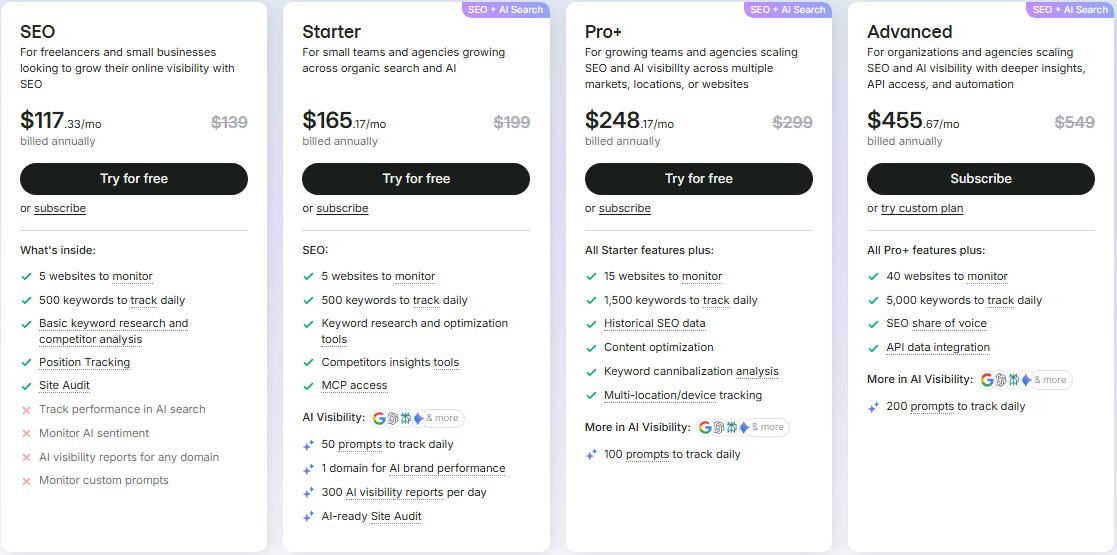
Semrush offers several pricing options depending on the features and level of usage you need. For beginners, the SEO plan is the most relevant starting point. It costs $139 per month when billed monthly, or $117.33 per month when billed annually.
The SEO plan includes essential tools such as keyword research, competitor analysis, Site Audit, and Position Tracking, making it suitable for freelancers, small businesses, and people getting started with SEO.
More advanced plans are available for users who need higher limits, historical data, content optimization, or more websites and keywords.
Is Semrush worth the price? For beginners, it can be a valuable investment if you plan to use its SEO tools regularly. However, if you are just learning SEO or have a very limited budget, starting with free SEO tools may be a better option.
1.Free options
Semrush offers limited free access, allowing beginners to try some of its SEO tools before paying for a subscription. The free version can be useful for basic keyword research and getting familiar with the platform, but it comes with restrictions on the number of searches, reports, and results available.
2.Paid plans
Semrush offers several paid plans for different SEO needs. Beginners can start with the entry-level plan and upgrade later if they need more features, data, or higher limits. Prices may change, so check the latest pricing before subscribing.
3.Which plan is suitable for beginners
For most beginners, Semrush Pro is the best paid starting point. It covers the essential SEO tools, including keyword research, competitor analysis, Site Audit, and rank tracking, without requiring the more advanced features of higher plans. Semrush describes Pro as suitable for freelancers, small businesses, and users managing a few projects.
If you’re just learning SEO or testing Semrush, the free account can be a better starting point. It provides limited access to keyword research, competitor research, Site Audit, and Position Tracking, so you can learn the platform before paying.
Start with the free account, then consider Pro once you need more data and higher limits. This is the most sensible path for a beginner.
Bottom line: Semrush is a powerful SEO platform, but its price may be high for beginners with a limited budget. If you are serious about SEO and expect to use its tools regularly, the investment can be worthwhile
8.Semrush Pros and Cons
Semrush is a powerful all-in-one SEO and digital marketing platform, but it is not perfect. Its biggest strengths are its wide range of SEO tools, competitive research, and reporting capabilities. However, its price and learning curve can be challenging for beginners.
- Pros of Semrush
1. All-in-One SEO Platform
Semrush brings keyword research, competitor analysis, Site Audit, backlink analysis, Position Tracking, content optimization, and other marketing tools into one platform. This can reduce the need to use several separate SEO tools.
2. Powerful Keyword Research
The Keyword Magic Tool helps you discover keyword ideas, analyze search demand, and identify opportunities for your content. This makes it particularly useful when planning new articles.
3. Strong Competitor Analysis
You can analyze competitors to discover their keywords, traffic opportunities, backlinks, and top-performing pages. This can help you find SEO opportunities that you may otherwise miss.
4. Useful Technical SEO Tools
Site Audit can identify technical issues that may affect your website, helping you prioritize problems and understand what needs to be fixed.
5. Advanced Tracking and Reporting
Semrush provides tools for monitoring keyword rankings, analyzing SEO performance, and creating reports. This is especially useful as your website grows.
6. AI Search Visibility Features
Semrush has expanded beyond traditional SEO with tools designed to monitor visibility in AI-powered search experiences. This gives users additional data as search behavior evolves.
- Cons of Semrush
1. Expensive for Beginners
The biggest drawback is the price. Semrush is a premium platform, and its cost can be difficult to justify if you are managing a small website or only need basic SEO features.
2. Steep Learning Curve
Semrush includes a large number of tools and reports. Beginners may initially find the dashboard overwhelming and need time to understand which features actually matter for their SEO strategy.
3. Usage Limits
Lower-tier plans have limits on projects, tracked keywords, reports, and other resources. These limits can become restrictive as your website or SEO workload grows.
4. Some Features Cost Extra
Certain advanced capabilities and add-ons can increase the total cost beyond the basic subscription. This is something to consider when calculating the real cost of using Semrush.
5. More Features Than Some Beginners Need
If you only want to perform basic keyword research or check a few rankings, Semrush may offer far more functionality than you actually need.
9.Semrush Alternatives
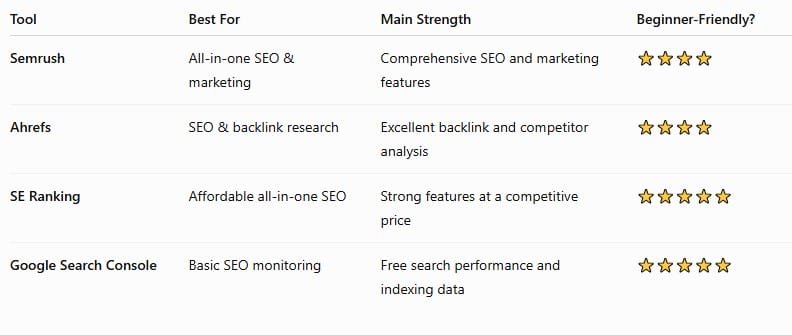
Semrush is a powerful all-in-one SEO platform, but it isn’t the only option. Depending on your budget and SEO goals, Ahrefs, SE Ranking, and Google Search Console can be strong alternatives.
The comparison table below highlights four popular SEO tools and their key differences.
1.Ahrefs — Marketing intelligence tools powered by Big Data
Ahrefs is one of the strongest alternatives to Semrush, particularly for backlink analysis, competitor research, keyword research, and SEO site analysis. Its current plans include tools such as Site Explorer, Keywords Explorer, Site Audit, and Rank Tracker.
Best for: Website owners and SEOs who want strong SEO and backlink data.
2.SE Ranking – Robust SEO software for every big task
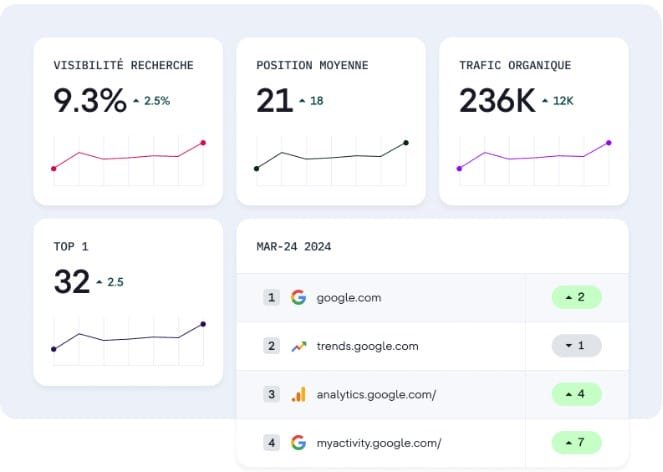
SE Ranking is a good alternative if you want a more affordable and straightforward SEO platform. It combines rank tracking, keyword research, competitor analysis, website auditing, and other SEO features in one platform.
Best for: Beginners, freelancers, small businesses, and growing websites that want good value.
3.Google Search Console
Google Search Console is completely different from the paid SEO platforms above. It is a free Google tool that shows how your website performs in Google Search, including clicks, impressions, queries, and indexing information.
Best for: Beginners who want to monitor their website’s Google Search performance for free.
10.Which Semrush Alternative Should You Choose?
The best Semrush alternative depends on your goals, budget, and the features you need most. Ahrefs is a strong choice for backlink and competitor research, while SE Ranking offers a good balance of features and affordability. If you only need basic SEO monitoring, Google Search Console is a free and simple option.
For beginners looking for an affordable all-in-one platform, SE Ranking is a particularly attractive alternative. If you need deeper backlink and competitor analysis, Ahrefs may be the better choice.
Choose Semrush if you want a comprehensive SEO and marketing platform.
Choose Ahrefs if your priority is SEO research and backlink analysis.
Choose SE Ranking if you want a simpler and more budget-friendly SEO platform.
Choose Google Search Console if you’re a beginner who wants essential SEO data without paying for an SEO subscription.
Bottom line: There is no single best Semrush alternative for everyone. The right choice depends on your budget, experience, and SEO goals. For beginners, starting with Google Search Console and adding a paid platform when you need deeper research can be a practical approach.
Conclusion:
Semrush is a powerful all-in-one SEO platform that can help beginners find keywords, analyze competitors, identify technical issues, optimize content, and track rankings. While its wide range of features may take some time to learn, you can start with the essential tools and gradually explore the platform as your SEO skills grow.
Overall, Semrush is a good choice for beginners who want a complete SEO toolkit and are ready to invest in their website’s growth. If the price is too high for your needs, alternatives such as SE Ranking or Google Search Console can provide more affordable or free options.
If you want one platform to manage most of your SEO tasks, Semrush is worth considering—especially as your website grows and your SEO needs become more advanced.