Online advertising is evolving as artificial intelligence changes how people search for information, discover products, and make purchasing decisions.
Google Ads is an established advertising platform that helps businesses reach people through search results and other placements. ChatGPT Ads introduces a new advertising opportunity within AI-powered conversations.
But what are the main differences between Google Ads and ChatGPT Ads? And where should marketers focus their attention in 2026?
In this guide, RankWise9 compares both platforms, explains their potential advantages, and shares five practical steps to prepare for the changing digital advertising landscape.
Table of Contents
1. What Are Google Ads and ChatGPT Ads?
1. What Is Google Ads?
Google Ads is an online advertising platform that allows businesses to promote their products and services through Google Search, YouTube, and other eligible placements.
Advertisers can use keywords, audience targeting, bidding strategies, and conversion tracking to reach potential customers and measure campaign performance.
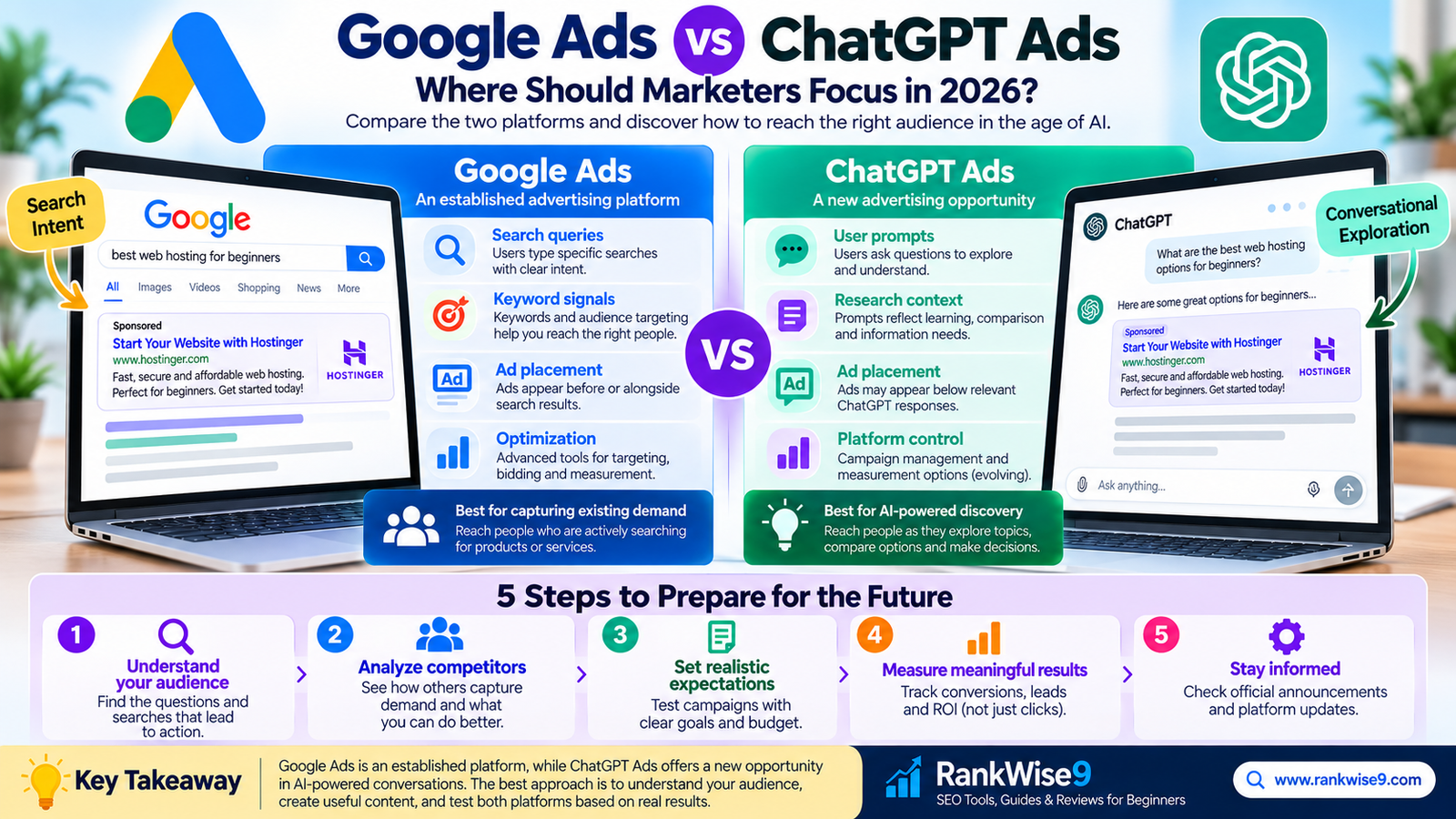
For example, a beginner looking for affordable web hosting may search for “best web hosting for beginners” and encounter relevant sponsored search results.
Google Ads is an established option for businesses that want to reach people searching for specific products, services, or solutions.
2. What Is ChatGPT Ads?
ChatGPT Ads is an official advertising offering from OpenAI that introduces sponsored content into the ChatGPT experience.
Depending on the available advertising format, eligible users may see clearly labeled advertisements alongside or below relevant responses.
Unlike a traditional search engine, ChatGPT allows users to ask questions, explore ideas, research products, and compare different solutions through conversations.
This creates a different advertising environment, where context and the user’s information needs may be important.
However, ChatGPT Ads is a newer platform, and its availability, targeting options, and measurement capabilities may differ from those of Google Ads.
2. Google Ads vs ChatGPT Ads: Key Differences
1. Search Queries vs. Conversational Prompts
Google Ads: Search queries can reveal what people want to find. Someone searching for “buy website hosting” may have a more immediate purchasing goal than someone searching for “what is web hosting?”
ChatGPT Ads: Users can ask questions such as “How do I create my first website?” or “Which SEO tools are suitable for beginners?” These conversations may reveal their interests and research needs.
Neither type of interaction guarantees that a user is ready to purchase.
2. Keywords vs. Conversational Context
Google Ads: Advertisers can use keyword targeting, audience signals, and campaign settings to reach relevant audiences.
ChatGPT Ads: Advertising takes place in a conversational environment. The available advertising controls and targeting options depend on OpenAI’s current offering and policies.
Marketers should verify the actual features available rather than assume that both platforms work in the same way.
3. Ad Placement
Google Ads: Search advertisements may appear above or below organic search results, depending on the search and advertising auction.
ChatGPT Ads: Advertisements may appear below relevant ChatGPT responses, with clear advertising labels. Their placement and eligibility depend on the current product experience.
4. Optimization and Measurement
Google Ads: Advertisers can use established campaign tools, bidding strategies, conversion tracking, and performance reports.
ChatGPT Ads: OpenAI offers advertising campaign management and measurement capabilities, but marketers should examine the available metrics and optimization options before comparing results directly with Google Ads.
3. Which Platform Should Marketers Choose?
The right choice depends on your audience, business objectives, budget, and campaign performance.
1. Choose Google Ads to Reach Existing Search Demand
Google Ads can be particularly useful when potential customers actively search for a product or service.
For example, a web hosting company can target relevant searches from people comparing hosting plans. Advertisers can then measure clicks, leads, sales, and other campaign outcomes.
Google Ads can also support awareness campaigns, so it is not limited to people who are ready to purchase.
2. Explore ChatGPT Ads for AI-Powered Discovery
ChatGPT provides a conversational environment in which users can explore unfamiliar subjects, ask follow-up questions, and compare possible solutions.
ChatGPT Ads creates an additional opportunity for eligible advertisers to reach audiences in this environment.
However, advertisers should evaluate the platform using actual campaign data rather than assuming that conversational advertising will automatically produce more engagement or conversions.
3. Consider Using Both Platforms
Google Ads and ChatGPT Ads do not necessarily need to compete for the same budget.
Where access and budget permit, businesses can test both platforms against clear objectives. They should compare results carefully, taking differences in attribution, available metrics, audience behavior, and campaign costs into account.
4. Five Ways to Prepare for the Future of Digital Advertising
1. Understand Your Audience
Study the questions your customers ask, the problems they want to solve, and the searches that lead to meaningful actions.
Use this information to improve your targeting, advertising messages, and website content.
2. Analyze Your Competitors
Review competitors’ websites, content strategies, product positioning, and advertising messages.
Look for opportunities to provide better information, explain your advantages, and answer questions that competitors overlook.
3. Set Realistic Expectations
Avoid moving your entire advertising budget to a new platform simply because it is attracting attention.
Define your goals, establish a testing budget, and decide what results would justify further investment.
4. Measure Meaningful Results
Clicks and impressions are useful, but they do not tell the whole story.
Where comparable data is available, evaluate metrics such as:
- Conversion rate
- Cost per lead
- Customer acquisition cost
- Qualified traffic
- Return on ad spend
Use consistent measurement methods whenever possible, and account for differences between platforms.
5. Stay Informed About AI Advertising
Advertising products change over time. Check official announcements, eligibility requirements, campaign options, and measurement tools before making important budget decisions.
For the latest information about availability, consult the official OpenAI Ads Manager Availability page.
5. Why SEO and Content Marketing Still Matter
Paid advertising is only one part of a successful digital marketing strategy.
Businesses also need useful, trustworthy content that answers customers’ questions and helps them make informed decisions.
For website owners and beginner bloggers, this means creating:
- Helpful guides that solve specific problems.
- Honest product reviews and comparisons.
- Clear answers to common search questions.
- Well-structured articles supported by reliable information.
- Fast, mobile-friendly pages with a good user experience.
For example, RankWise9 helps beginners explore SEO tools, website creation, digital marketing, and AI-powered solutions.
By publishing practical guides and useful resources, RankWise9 can build organic visibility and help readers discover solutions that fit their needs.
A strong content strategy can complement paid advertising while supporting long-term website growth.
6. Should You Focus on Google Ads or ChatGPT Ads in 2026?
There is no universal winner.
Google Ads is an established platform with a mature advertising ecosystem. ChatGPT Ads offers a newer way for eligible advertisers to reach users in an AI-powered conversational environment.
Your decision should depend on your business objectives, available budget, audience, and measured results.
If Google Ads is already generating profitable conversions, do not abandon it without a clear reason. If ChatGPT Ads is available to your business, consider controlled experiments to determine whether it adds value.
The goal is not to follow every new trend. It is to identify the channels that help your business reach the right audience efficiently.
7. Conclusion
The digital advertising landscape is expanding beyond traditional search experiences.
Google Ads remains an important option for businesses seeking to reach audiences through established advertising channels. ChatGPT Ads introduces another opportunity as AI-powered conversations become part of how people explore information and evaluate solutions.
For marketers, the most practical approach is to understand their audience, create useful content, measure campaign performance, and test new opportunities carefully.
The future of advertising is not simply about choosing between Google and AI. It is about understanding your audience and reaching the right people with the right message at the right time.
Follow RankWise9 for more beginner-friendly guides on SEO, online advertising, AI tools, and website growth.
8. Frequently Asked Questions
Is Google Ads better than ChatGPT Ads?
It depends on your goals. Google Ads is an established advertising platform, while ChatGPT Ads offers a newer advertising environment. Compare their actual performance against your business objectives.
Is ChatGPT Ads officially available?
OpenAI has introduced ChatGPT Ads and provides official information about advertising access and availability. Eligibility and features depend on the current offering and market.
Should small businesses try ChatGPT Ads?
Eligible small businesses may consider testing it if the platform fits their audience and budget. Start with clear objectives and evaluate actual results before increasing spending.
Will AI advertising replace Google Ads?
There is no reason to assume that AI advertising will completely replace Google Ads. Businesses may continue using different channels to reach audiences at different stages of the customer journey.
How can beginners prepare for AI advertising?
Start by understanding your audience, improving your website, creating helpful content, tracking conversions, and following official platform announcements.