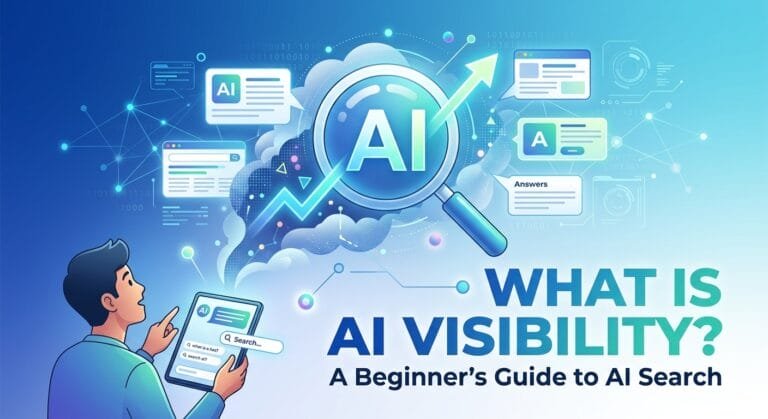

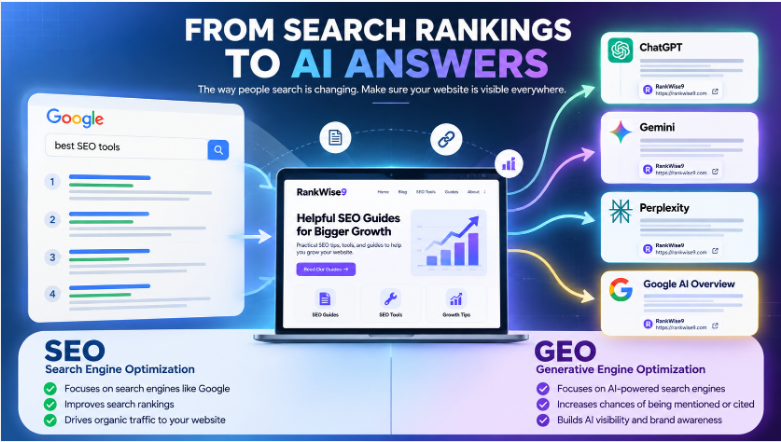
The way people search for information online is rapidly evolving. Instead of browsing through a traditional list of links on Google, users are increasingly turning to AI-powered platforms like ChatGPT, Gemini, and Perplexity to get direct, synthesized answers.
This shift creates a critical challenge for website owners: How do you maintain your brand presence when AI generates the answers instead of a search engine page?
While traditional SEO focuses on climbing search engine result pages (SERPs), ranking high on Google is no longer the only game in town. Your content must now be clear, authoritative, trustworthy, and structured in a way that AI systems can easily parse, understand, and reference.
Enter Generative Engine Optimization (GEO)—the practice of optimizing your content to be cited, mentioned, and recommended in AI-generated responses.
In this guide, you’ll discover what GEO is, how it works, how it differs from traditional SEO, and actionable strategies to future-proof your online visibility.
Let’s start with the basics.
Table of Contents
1. What Is GEO (Generative Engine Optimization)?
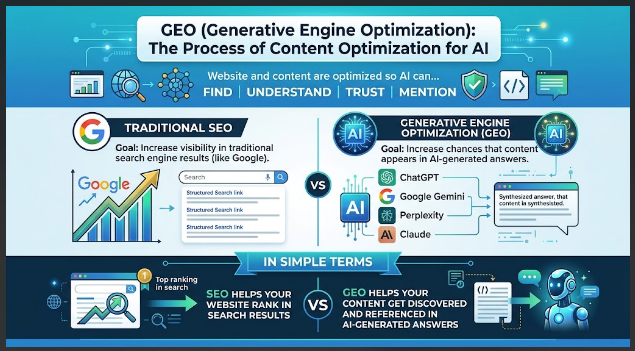
Generative Engine Optimization (GEO) is the practice of optimizing your website and content so that AI-powered search engines can find, understand, trust, and cite your brand in their answers.
- SEO helps your website rank in traditional search engine results pages (like Google).
- GEO increases the chances that your content will be referenced in AI-generated responses across platforms like ChatGPT, Google Gemini, Perplexity, and Claude.
In simple terms: SEO helps you rank on Google, while GEO helps you get cited by AI.
2. How Does GEO Work?
Generative Engine Optimization (GEO) works by making your website content easier for AI-powered search platforms to discover, understand, evaluate, and reference when generating answers.
Unlike traditional search engines, which mainly display a list of ranked web pages, AI platforms such as ChatGPT, Google Gemini, and Perplexity can analyze information from multiple sources and combine it into a single response.
3. GEO vs SEO: What’s the Difference?
While both SEO (Search Engine Optimization) and GEO (Generative Engine Optimization) share the ultimate goal of connecting users with your content, they operate on fundamental differences in technology, user intent, and optimization strategies.
Here is a side-by-side comparison to help you understand how they differ:
📊 Comparison Table
| Feature | Traditional SEO | Generative Engine Optimization (GEO) |
| Primary Goal | Rank high on search engine result pages (SERPs). | Get cited, recommended, and referenced in AI responses. |
| Target Platforms | Google, Bing, Yahoo, DuckDuckGo. | ChatGPT, Google Gemini, Perplexity, Claude, Copilot. |
| User Interaction | User clicks on a link from a list of web pages. | User reads a synthesized, direct answer generated by AI. |
| Optimization Focus | Keywords, title tags, meta descriptions, backlinks, site speed. | Clear facts, authoritative data, structured schema, context, and citable statements. |
| Content Structure | Optimized for web page skimming and search bots. | Structured for deep natural language understanding (NLE/LLM context). |
| Success Metrics | Organic rankings, click-through rates (CTR), web traffic. | Brand mentions, AI citations, answer inclusion, domain sentiment. |
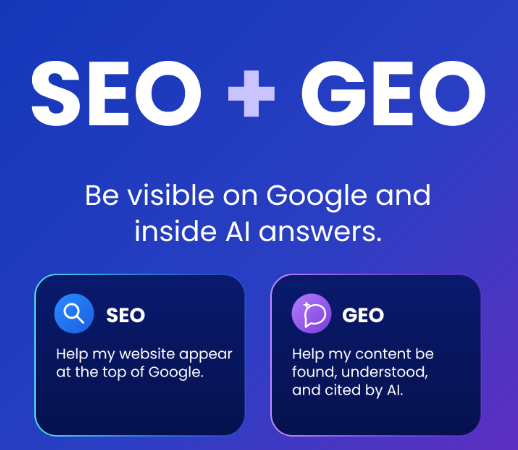
Key Takeaway
- SEO is about getting people to click on your link.
- GEO is about getting AI models to trust and quote your information.
4. Why Is GEO Important in 2026?
Generative Engine Optimization (GEO) is becoming increasingly important as the way people search for and discover information continues to change. Search is no longer limited to traditional website rankings; users are increasingly relying on AI-generated answers from platforms such as ChatGPT, Perplexity, Gemini, Claude, and Google’s AI Overviews. If a brand, product, or business is not mentioned, recommended, or cited in these AI-generated answers, it risks missing valuable opportunities to reach potential customers. GEO helps businesses improve their visibility across these emerging AI-powered search experiences and stay competitive in the evolving digital landscape.
5. How to Optimize Your Website for GEO (7 Practical Strategies)
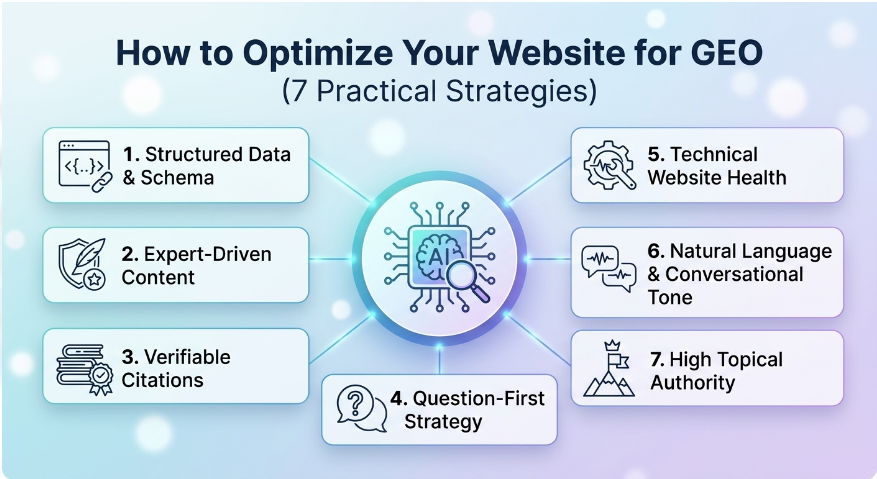
Optimizing your website for GEO (Generative Engine Optimization) doesn’t mean abandoning traditional SEO. Instead, it means improving your content so that AI-powered platforms like ChatGPT, Google Gemini, and Perplexity can discover, understand, and potentially reference your website when answering users’ questions.
The good news is that many GEO techniques are closely related to good SEO practices. By creating helpful content, organizing your information clearly, and building your website’s credibility, you can improve your chances of appearing in AI-generated answers.
Here are 7 practical GEO strategies you can start applying to your website in 2026.
1. Create Helpful, High-Quality Content
Content quality is one of the most important foundations of GEO.
AI-powered platforms need relevant information to answer users’ questions. Creating original, accurate, and useful content can make your website a valuable source of information.
Instead of writing articles just to target keywords, focus on solving real problems for your audience.
For example, if you run an SEO blog, you could publish articles such as:
- What Are SEO Tools and How Do They Work?
- Best Free SEO Tools for Beginners.
- How to Find Keywords for Your Website.
- How to Fix Common Technical SEO Issues.
Practical tip: Write content that answers specific questions, provides useful examples, and gives readers actionable solutions.
2. Answer Questions Clearly and Directly
AI platforms often generate answers to specific questions. Making your content easy to understand can help these systems identify relevant information.
Try to answer the main question immediately after each heading instead of making readers go through several paragraphs to find the answer.
For example:
Question: What is keyword research?
Keyword research is the process of finding and analyzing the search terms people use on Google and other search engines to discover information, products, or services.
This short definition gives readers a direct answer before providing more detailed explanations.
Practical tip: Include question-based headings, short definitions, FAQs, and clear explanations throughout your articles.
3. Organize Content with Clear Headings
A well-organized article is easier for readers to navigate and understand.
Use a logical heading structure to explain your topics step by step.
For example, an article about SEO tools could follow this structure:
– H1: Best SEO Tools for Beginners in 2026
- H2: What Are SEO Tools?
- H2: Why Do Beginners Need SEO Tools?
- H2: Best Free SEO Tools
- H3: Google Search Console
- H3: Google Analytics
- H3: Ahrefs Webmaster Tools
- H2: How to Choose the Right SEO Tool
You can also use bullet points, numbered lists, and comparison tables to present information clearly.
Practical tip: Keep your headings descriptive and make sure each section focuses on one main topic.
4. Build Website Authority and Credibility
Trust is important when creating content that you want people and AI-powered platforms to rely on.
Your website should demonstrate that the information you publish is accurate, relevant, and supported by experience or reliable evidence.
Here are some ways to strengthen your website’s credibility:
- Publish content based on research and practical experience.
- Include references to reliable sources when necessary.
- Create detailed author biographies.
- Update outdated articles and statistics.
- Earn relevant backlinks from reputable websites.
- Maintain consistent information about your brand.
Practical tip: Don’t just repeat information available everywhere. Add original insights, examples, comparisons, and practical recommendations.
5. Optimize Technical SEO
Technical SEO helps search engines access, crawl, and understand your website.
Although technical SEO does not guarantee AI visibility, it provides an important foundation for making your content accessible.
Focus on these essential elements:
- HTTPS: Secure your website with an SSL certificate.
- Mobile-friendly design: Make sure your website works properly on smartphones and tablets.
- Page speed: Improve loading times and overall user experience.
- XML Sitemap: Help search engines discover your important pages.
- Robots.txt: Avoid unintentionally blocking important content.
- Internal linking: Connect related articles to help users and search engines navigate your website.
- Structured data: Use relevant Schema markup to describe your content.
Practical tip: Use Google Search Console to monitor indexing issues and identify technical problems affecting your website.
6. Use Structured Data
Structured data helps search engines understand specific information about your website and its pages.
For example, Schema markup can describe:
- Articles and blog posts.
- Products and services.
- Organizations and businesses.
- Frequently asked questions.
- Breadcrumb navigation.
You can also improve content formatting by using descriptive titles, meaningful headings, lists, and tables.
Remember that structured data does not guarantee that your website will appear in AI-generated answers. Its main purpose is to provide search engines with additional context about your content.
Practical tip: If you use WordPress, SEO plugins such as Rank Math and Yoast SEO can help you implement relevant Schema markup.
7. Monitor AI Search Visibility
Optimizing your website is only the beginning. You should also monitor how your brand and content appear across AI-powered platforms.
For example, you can test questions related to your niche using:
- ChatGPT.
- Google Gemini.
- Perplexity.
- Other AI-powered search platforms.
Try asking questions related to your articles and check whether your website is mentioned or cited.
You can also explore dedicated AI visibility tools to monitor brand mentions, citations, and changes in visibility over time.
Practical tip: Create a list of questions related to your niche and regularly check whether your website appears in relevant AI-generated answers. Treat these checks as indicators rather than a complete measurement of AI visibility.
6. Best GEO and AI Visibility Tools
You don’t need an enterprise budget to start tracking your AI visibility. The right tool depends on what you already use and how much data you actually need.
1. Rank Math AI Visibility (best for wordPress sites)
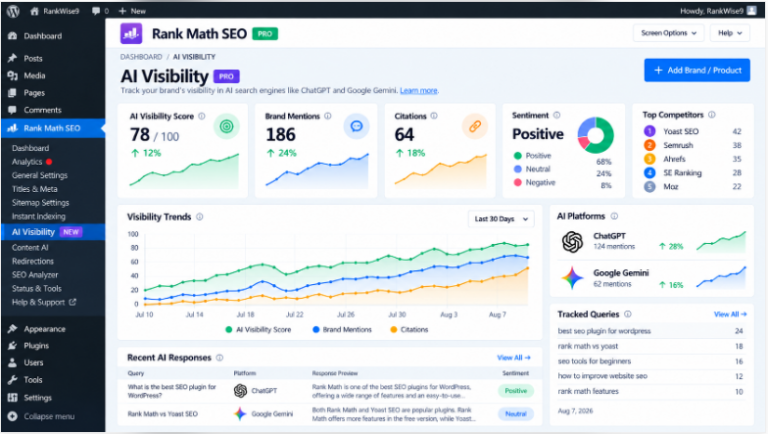
Rank Math now bundles Content AI, AI Link Genius, and AI Visibility under one “Rank Math AI” offering, and its tracking covers both ChatGPT and Google Gemini. Once the module is enabled, you add a brand or product from your WordPress dashboard and monitor it from there. You can follow brand mentions, sentiment, the citations that influence AI answers, and how you compare with competitors.
Best for: bloggers, small businesses, and anyone already running Rank Math who wants GEO and SEO in the same dashboard.
Keep in mind: it requires an active paid subscription (Content AI / Rank Math AI), and platform coverage is narrower than the dedicated tools below.
Explore Rank Math AI: Get Rank Math AI
Affiliate disclosure: This article contains affiliate links. If you purchase through my link, I may earn a commission at no additional cost to you.
2. Semrush AI Visibility Toolkit (best if you already use Semrush)
It combines visibility, competitor analysis, prompt research, prompt tracking, and an AI Search Site Audit in one workflow. It is the lowest-friction choice if Semrush is already part of your stack.
3. Ahrefs Brand Radar (best for broad data)
Ahrefs says Brand Radar covers more than 405 million search-backed prompts across seven AI platforms. Strong for teams already living in Ahrefs, but the add-on model can get expensive once you track several platforms.
4. Profound(best for enterprises)
A standalone platform with deep analytics on answer engines and citations. It is the pick when AI visibility is a real budget line rather than a checkbox next to SEO.
5. Peec AI and Otterly.ai(best for agencies and tight budgets)
Peec AI is popular with agencies tracking several brands. Otterly.ai is described as the cheapest credible entry point for startups, covering four major answer engines with daily tracking.
Which one should you pick?
| Your situation | Start with |
|---|---|
| WordPress blog or small site | Rank Math AI Visibility |
| Already paying for Semrush | Semrush AI Visibility Toolkit |
| Already paying for Ahrefs | Ahrefs Brand Radar |
| Agency or tight budget | Peec AI or Otterly.ai |
| Enterprise with dedicated budget | Profound |
7. How to Measure Your AI Search Visibility
Measuring your AI search visibility helps you understand how often your website or brand appears in AI-generated answers across platforms such as ChatGPT, Google Gemini, and Perplexity.
Unlike traditional SEO, where you can monitor keyword rankings, clicks, and impressions through tools like Google Search Console, AI visibility requires looking at additional metrics, including brand mentions, AI citations, competitor presence, and referral traffic.
By tracking these indicators, you can understand how AI platforms present your brand, identify opportunities to improve your content, and measure the effectiveness of your GEO strategy.
8. Common GEO Mistakes to Avoid
Generative Engine Optimization (GEO) can help your website gain visibility in AI-generated answers, but some common mistakes can limit your results. To improve your chances of being mentioned and cited by AI platforms like ChatGPT, Gemini, Claude, and Perplexity, avoid these mistakes:
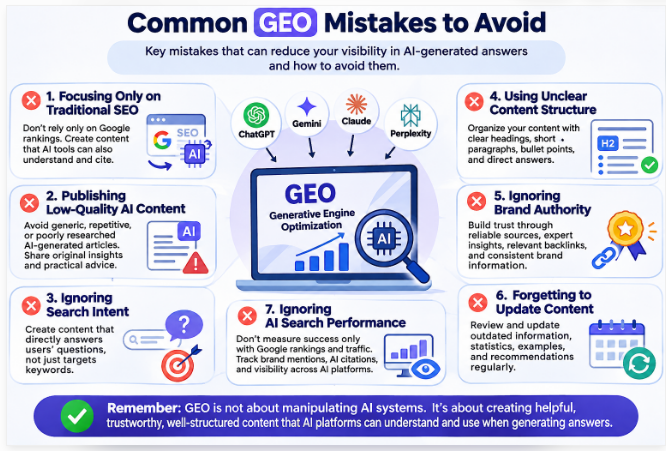
1. Focusing Only on Traditional SEO: Don’t focus exclusively on Google rankings. Create content that is also easy for AI systems to understand, retrieve, and reference.
2. Publishing Low-Quality AI Content: Avoid publishing generic, repetitive, or poorly researched AI-generated articles. Focus on original information, expertise, and practical advice.
3. Ignoring Search Intent: Create content that directly answers users’ questions instead of focusing only on keywords.
4. Using Unclear Content Structure: Organize articles with descriptive headings, short paragraphs, bullet points, and clear answers to make information easier to understand.
5. Ignoring Brand Authority: Build trust through reliable sources, expert insights, relevant backlinks, and consistent brand information across the web.
6. Forgetting to Update Content: Review and update outdated information, statistics, examples, and recommendations regularly.
7. Ignoring AI Search Performance: Don’t measure success only through Google rankings and organic traffic. Monitor brand mentions, AI citations, and visibility across different AI platforms.
Remember: GEO is not about manipulating AI systems. It’s about creating helpful, trustworthy, well-structured content that AI platforms can understand and use when generating answers.
9. The Future of SEO and GEO
The future of digital visibility will combine traditional Search Engine Optimization (SEO) with Generative Engine Optimization (GEO). While SEO helps websites rank in search engine results and attract organic traffic, GEO focuses on making content easier for AI platforms like ChatGPT, Gemini, Claude, and Perplexity to understand, retrieve, and cite in their answers.
As search technology continues to evolve, businesses and website owners will need to optimize for both traditional search engines and AI-powered answer engines. This means creating helpful, original, trustworthy, and well-structured content while building brand authority and answering users’ questions clearly.
The key takeaway: SEO is not disappearing; it is evolving. Combining SEO and GEO can help businesses increase their online visibility, reach new audiences, and stay competitive as people increasingly use AI to discover information, products, and services.
10. Frequently Asked Questions
1. What is GEO in SEO?
GEO stands for Generative Engine Optimization. It is the process of optimizing website content to improve its chances of appearing in AI-generated answers from platforms like ChatGPT, Gemini, Claude, and Perplexity.
2. What is the difference between SEO and GEO?
SEO focuses on improving website rankings in traditional search engines like Google, while GEO focuses on increasing the chances of being mentioned or cited in AI-generated answers.
3. Why is GEO important?
GEO helps businesses improve their visibility in AI-powered search experiences, reach potential customers, build brand authority, and stay competitive as online search evolves.
4. How can I optimize my website for GEO?
You can improve GEO by:
- Publishing helpful, original, and accurate content.
- Answering users’ questions clearly.
- Using descriptive headings and structured content.
- Building brand authority and earning quality backlinks.
- Updating outdated information regularly.
- Using relevant statistics and trustworthy sources.
5. Does GEO replace traditional SEO?
No. GEO does not replace SEO. Both strategies complement each other. SEO helps websites rank in traditional search results, while GEO helps content become more visible in AI-generated answers.
6. Which AI platforms should I optimize for?
Focus on major AI-powered platforms such as ChatGPT, Google Gemini, Claude, and Perplexity. Each platform may retrieve and present information differently.
7. How can I measure AI search visibility?
You can monitor brand mentions, citations, linked sources, and the frequency with which your website appears in AI-generated answers. Specialized AI visibility tools can also help track performance.
8. What are the best GEO tools?
Several SEO and AI visibility tools can help you monitor and improve your online presence, including Semrush, Ahrefs, SE Ranking, and Rank Math AI.
9. Is GEO important for small websites and beginners?
Yes. Small websites and new blogs can benefit from GEO by publishing valuable, well-organized, trustworthy content that directly answers their target audience’s questions.
10. Will GEO change the future of digital marketing?
GEO is becoming an important part of digital marketing as people increasingly use AI tools to research products, compare services, and discover information. Combining SEO and GEO can help businesses adapt to these changes.
Conclusion
Generative Engine Optimization (GEO) is changing how businesses and website owners approach online visibility. As AI-powered platforms like ChatGPT, Gemini, Claude, and Perplexity become increasingly popular, creating content that AI systems can understand, trust, and cite is becoming an important part of digital marketing.
For beginners, the best approach is to start with strong SEO fundamentals and gradually adopt GEO strategies. Focus on publishing helpful, original, well-structured content, answering users’ questions, building brand authority, and monitoring your visibility across AI platforms.
Remember, GEO does not replace SEO; it complements it. Combining both strategies can help your website reach more people, attract new audiences, and remain competitive as the search experience continues to evolve.